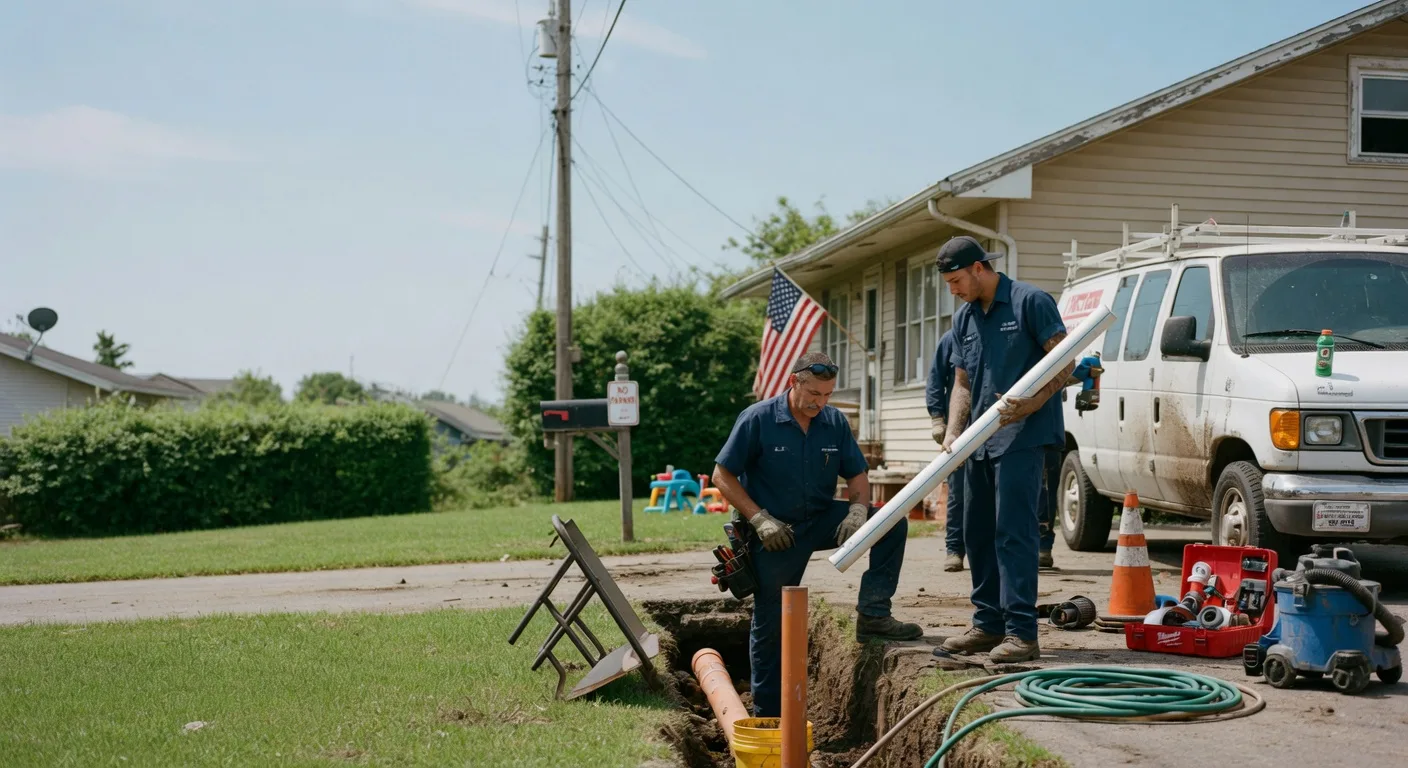
What is a cleanout and why does the plumber keep asking if I have one?
A cleanout is a capped pipe fitting that gives a plumber direct access to the sewer line. It usually looks like a round plug, three or four inches across, sitting on a short stub of pipe. You will often find one in the basement near the main stack, in a crawlspace, along an outside wall or in the yard near the foundation.
The plumber asks because it decides how the job is done. With a cleanout, a cable machine or hydro jetter goes straight into the line. Without one, the equipment has to go in through a toilet, a floor drain or the roof vent. That can mean pulling a toilet, and it limits how far the machine travels and how well a camera can see.
Safe homeowner check: find the cap and note where it is. Do not unscrew it if the house drains are backed up. Water can be standing behind the cap, and it will come out.
Stop running water and call now if the cleanout is wet or leaking, or if several drains in the house are backing up together. That points to a blockage in the main line.
If your home has no cleanout, adding one is often part of the job. What it costs depends on access, how deep the line is, how much has to be dug or cut open, and whether a permit applies.
Expert Plumbers Co is a referral service. Call (380) 262-9173 and we will connect you with a plumber serving Worthington, IA for Drain Cleaning.
A few practical points help when a cleanout is involved. The cap can be stuck from years of rust or paint, and forcing it with a long wrench can crack the fitting, so leave a stubborn one to the plumber. Keep the area around it clear of storage, snow, soil or landscaping so the crew can reach it quickly. In older homes the cleanout may have been buried when the yard was regraded, or covered by a patio or flooring, and finding it can take some probing. Newer homes usually have one near the foundation or at the property line, sometimes with a green or black cap flush with the lawn. If a plumber can find or install one, later cleanings and camera inspections become simpler and less disruptive, because the equipment enters the line at a planned point and nothing indoors has to be disturbed or removed.
Why do my drains back up only when I run the washing machine?
When the washing machine drains and water comes up in the shower or a floor drain, the machine is rarely the problem. It dumps a lot of water in a short burst, and the line behind it cannot carry that volume away. Something is narrowing the pipe: grease and lint built up on the pipe wall, roots pushing in at a clay joint, or a bellied section that holds water and slows the flow.
Where it shows up tells you a lot. If only the laundry standpipe overflows, the blockage is probably in the branch line serving the machine, and a cable machine often clears that. If the lowest drains in the house gurgle or back up too, the blockage is further down, in the main line or a failed sewer lateral. That is a different job. It usually calls for hydro jetting or a camera inspection to see what is actually in there.
Safe homeowner checks: make sure the drain hose is not jammed tight into the standpipe, and try a smaller load. Do not keep running loads to see if it clears. Every cycle pushes more water toward the lowest opening in the house.
If water is coming up inside the house, stop using the washer, sinks and toilets and call. Expert Plumbers Co is a referral service, not a plumbing company. We refer you to a local plumber for Drain Cleaning in Worthington, IA: (380) 262-9173.
Watch for a pattern in when it happens, because that helps separate a drain problem from a venting or plumbing layout issue. If the backup always appears on the second or third load, the line is partly blocked and fills as the volume builds. If the washer is on a long run that ties into the main near a bathroom, the surge can push air and water into the nearest fixtures. Older homes often have laundry drains that were added later with a smaller pipe or an awkward connection, which cannot keep pace with a modern machine. A common mistake is placing a lint trap on the end of the drain hose and assuming it solves everything. It catches fibers, but it does not clear buildup already in the pipe. Tell the plumber the machine type and how many loads you run in a day.
Sewage has backed up into my basement. What do I do right now?
Stop running water in the house now. That means toilets, sinks, showers, the washing machine and the dishwasher. Every gallon you send down the line has nowhere to go but out through the lowest opening, which is your basement floor drain.
Stay out of the water. Keep children and pets away. If you must go in, wear boots and gloves, and do not touch outlets or appliances while standing in it. Do not pour chemical cleaners down any drain.
One safe check: look at whether other drains upstairs are gurgling or slow. If they are, the main sewer lateral is blocked or failing. Typical causes are root intrusion at a clay joint, grease build-up on the pipe wall, a bellied line holding water, or a collapsed section. A single slow fixture is a branch line problem. A basement backing up with the whole house affected is a main line problem, and it needs different equipment.
This is Emergency Drain Cleaning, and it is not a homeowner job. A cable machine at the cleanout can clear a soft blockage. Roots and grease usually need hydro jetting, and a camera inspection shows why the line stopped.
Cost depends on cleanout access, what is found in the pipe, how much has to be removed or repaired, and any permit requirement. Expert Plumbers Co is a referral service. Call (380) 262-9173 and we will refer you to a plumber serving Worthington, IA.
Once the water is stopped, take photos of the water line and the affected items before anything is moved, and write down the time you first noticed it. If the backup is sewage, do not use a wet vacuum or a household fan on it, and do not start throwing out porous items until the plumber has opened the line. Tell the plumber what ran just before the backup, such as a load of laundry or a long shower, and whether the floor drain or a basement toilet was the first place it showed. In an older home with a clay or cast iron lateral, the cause is often roots or a collapsed section. In a newer home it is more often a belly, a joint that was set poorly, or a heavy wipe or grease blockage. After the line is cleared, the floor and walls still need proper cleaning and drying, and that is separate from the plumbing repair.
Why did the clog come back worse after I used a store-bought drain snake?
You ran a snake from the hardware store, the water moved for a day, and now the sink is worse than before. That is common, and it comes down to the tool.
A thin hand-crank snake often punches a small hole through the middle of a clog. Water trickles through, so it seems fixed. The clog is still there, and it gets packed tighter as new debris catches on it. Sometimes the snake pushes the clog deeper into a bend, where it is harder to reach. A snake also does not scrape the pipe wall, so the grease build-up stays and the clog forms again quickly.
It is the wrong tool for roots, a bellied line holding water, or scale in cast iron. Those need a heavier cable with a cutting head, hydro jetting, or a camera inspection to see what is actually in the pipe.
Safe homeowner check: place a bucket under the trap, remove it and clear it by hand. Do not add chemical cleaners after snaking, because the plumber may then be working in caustic water.
Stop running water and call if the snake stuck or will not come back out, if other drains gurgle or back up, or if you smell sewage. That points past a single fixture to the main line.
Cost depends on access, what is found, and how much has to be opened up. Expert Plumbers Co is a referral service. Call (380) 262-9173 for Drain Cleaning help from a plumber serving Worthington, IA.
After a failed snake attempt, leave the fixture alone and tell the plumber exactly what you did: the type of snake, how far it went in, whether it hung up, and whether you used any chemical cleaner first. That saves time on site and tells them whether the cable is still stuck or the clog was pushed into a bend. Do not keep running the snake in the hope that it will break through. Forcing a thin cable through a trap or a sharp bend can scratch the pipe wall or damage the trap, and in old cast iron it can knock loose scale that adds to the blockage. Also stop using the sink for a few hours if you can, because the extra water tends to carry loose debris deeper. Expect the proper clearing to include a look at the pipe wall afterwards, so you know whether this was a one-off blockage or a pipe that keeps catching debris.
I rent out my place and the tenant says the drains are backing up. What should I ask them, and what should I arrange?
Start with a few plain questions, because the answers tell the plumber where the problem is before anyone arrives.
Ask the tenant which fixtures are affected. One slow sink or tub points to a clog in that fixture's own branch. If several drains are slow, or water rises in a tub or shower when the toilet is flushed or the washer empties, the main line is the likely culprit.
Ask when it started and what changed. Did it follow heavy rain, a laundry day, a large gathering, or a new habit such as flushing wipes? Ask whether there are gurgling sounds, a sewage smell, or water in a floor drain or basement. Ask whether anything has already been tried, especially chemical cleaners, since those are a hazard to whoever opens the pipe next.
Ask for photos or a short video of the fixtures. That is faster than a long phone call and helps if you are not living nearby.
What to tell the tenant right away: stop running the washer and dishwasher, go easy on the toilets, and do not pour cleaner down the drain. If sewage is coming up inside the home, or water is spreading across a floor, treat it as urgent and keep people and pets out of the wet area.
What to arrange: a plumber to clear the line and, if the same drain has failed before, a camera look at it. Offer the plumber the tenant's contact details and agreed times so access is not the delay. Ask whether the blockage was in the fixture branch or the main line, and whether the plumber thinks it was caused by tree roots, a sagging pipe or something that was flushed. That tells you whether it is a one-off or a repair item.
Keep notes: dates, photos, what the plumber found. Whether the cause is wear or misuse affects the conversation with the tenant, so write down what was seen rather than what was assumed. Check your lease and local rules for your own obligations.
Expert Plumbers Co can connect you with an independent plumber in Worthington, IA for this: call (380) 262-9173.